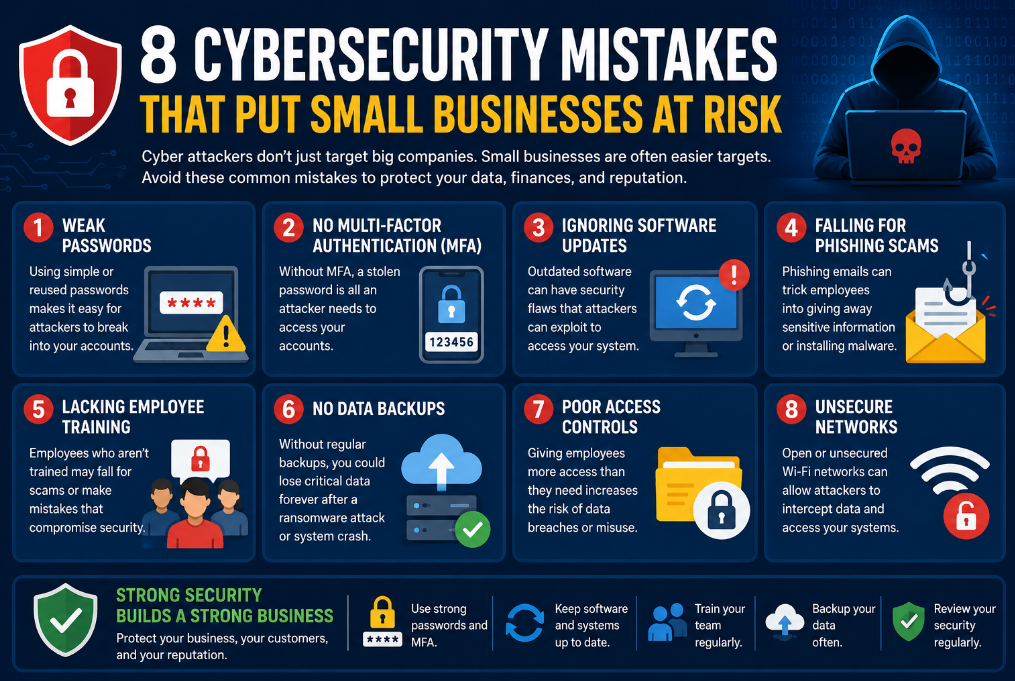
In the modern digital landscape, small and medium-sized enterprises (SMEs) are the backbone of the global economy. Unfortunately, they are also the primary target for cybercriminals. A common misconception among small business owners is that hackers only focus on large corporations with deep pockets. In reality, automated cyber attacks scan the web indiscriminately, exploiting vulnerable defenses wherever they find them.
Because small businesses often lack dedicated IT security departments or massive enterprise security budgets, a single security lapse can lead to devastating financial loss, permanent data corruption, and ruined customer trust. Avoiding critical oversight is the first step toward building a resilient organization. Below are 8 cybersecurity mistakes that put small businesses at risk and how you can fix them before it’s too late.
1. Believing “We Are Too Small to Be Targeted”
The most dangerous myth in business today is security obscurity. Many small business owners assume hackers will overlook them in favor of massive tech giants or financial institutions.
- The Reality: Cybercriminals frequently target SMEs because smaller organizations typically have weaker security postures, making them easier entry points. Furthermore, hackers often use automated scripts to breach hundreds of small businesses simultaneously to execute ransomware attacks or steal customer credentials.
- The Fix: Adopt a zero-trust mindset. Assume your business data is valuable, and implement baseline security protocols regardless of your company’s head count.
2. Neglecting Regular Software and System Updates
When a notification pops up reminding you to update your operating system, browser, or software plugins, it is easy to click “Remind Me Later” to avoid a temporary disruption.
- The Reality: Software updates rarely include aesthetic changes alone; they frequently patch newly discovered vulnerabilities (zero-day exploits) that hackers actively scan for. Running outdated software is equivalent to leaving your office door unlocked because the deadbolt needs minor maintenance.
- The Fix: Enable automatic updates across all business devices, operating systems, and SaaS platforms. Regularly audit your digital workspace to ensure obsolete software is completely uninstalled.
3. Using Weak or Reused Passwords
Password fatigue is real, leading many employees to use simple passwords like “Password123” or reuse the same credentials across both personal accounts and corporate applications.
- The Reality: If a cybercriminal breaches an employee’s personal streaming account using a compromised password, they will often test those exact credentials on corporate email portals and customer relationship management (CRM) systems through automated credential stuffing attacks.
- The Fix: Mandate strong, complex passwords and deploy an enterprise-grade password manager. Most importantly, enforce Multi-Factor Authentication (MFA) across every single company account.
4. Failing to Implement Multi-Factor Authentication (MFA)
Relying solely on a username and password is no longer sufficient to protect sensitive company files and customer databases.
- The Reality: Phishing campaigns and keyloggers can easily capture standard login credentials. Without an extra layer of verification, a compromised password grants an unauthorized attacker immediate, unrestricted access to your entire digital infrastructure.
- The Fix: Turn on MFA everywhere. Requiring a secondary verification method—such as an authenticator app code or hardware token—stops the vast majority of automated credential-based attacks in their tracks.
5. Skipping Regular Data Backups and Recovery Testing
Many small business owners assume that storing files in the cloud means they are completely safe from data loss.
- The Reality: While cloud storage protects against physical hardware failure, it does not automatically protect against sophisticated ransomware infections, accidental deletion, or malicious insider threats that can corrupt or lock files across your cloud environment. Furthermore, backups that are continuously connected to your network can also be encrypted by ransomware.
- The Fix: Follow the 3-2-1 backup rule: keep 3 copies of your data, on 2 different media types, with at least 1 copy stored offline or in an immutable cloud repository. Crucially, test your disaster recovery protocols regularly to ensure files can actually be restored.
6. Overlooking Employee Security Awareness Training
Your network security is only as strong as your weakest link—and that link is frequently human error.
- The Reality: Cybercriminals specialize in social engineering, manipulating well-meaning employees through convincing phishing emails, urgent text messages (smishing), or fraudulent phone calls to hand over administrative credentials or transfer funds. Technical firewalls cannot block an employee who willingly hands over the keys.
- The Fix: Conduct regular, mandatory cybersecurity training for all staff members. Run simulated phishing tests to educate your team on how to spot red flags, verify sender addresses, and report suspicious activity.
7. Providing Employees with Excessive Access Permissions
In a spirit of workplace trust or operational convenience, many small businesses grant all employees full administrative access to company servers, databases, and financial applications.
- The Reality: If a single employee falls victim to a phishing attack, an attacker inherits whatever access rights that employee holds. Giving broad permissions creates an expansive blast radius if an account is compromised.
- The Fix: Implement the Principle of Least Privilege (PoLP). Ensure that workers only have access to the specific files, folders, and software tools required to perform their direct job responsibilities.
8. Lacking an Incident Response Plan
Many small businesses operate under the assumption that “it won’t happen to us,” meaning they spend zero time planning for what to do if a breach actually occurs.
- The Reality: When a ransomware attack or data breach hits, every minute of confusion costs money, harms customer trust, and worsens regulatory compliance penalties. Panicking without a structured playbook leads to delayed communications and compounded damage.
- The Fix: Create a clear, written Incident Response Plan (IRP). Define who to contact internally, which external IT security experts or legal counsel to engage, how to isolate infected systems, and when to notify affected clients or stakeholders.
Conclusion
Securing a small business does not require a million-dollar corporate security budget; it requires vigilance, smart policy enforcement, and closing the basic vulnerabilities that hackers look for. By recognizing these 8 common cybersecurity mistakes and proactively hardening your defense systems, you safeguard your enterprise’s financial health and operational integrity.
To explore more about how modern software architecture protects business data and streamlines operations, check out our guide on The Ultimate Guide to Finding the Best CRM SaaS for Your Business or learn about enterprise workflow efficiency in Seamless Integration: The Power of CRM and ERP United.