Every single morning, millions of professionals open their browsers facing the same digital mountain: overflowing inboxes, dense financial reports, messy codebases, and strategic marketing plans waiting to be written. In 2026, generative artificial intelligence is no longer a futuristic novelty or a toy for tech enthusiasts; it is the core operating system of modern productivity. Yet, as the market matures, a new dilemma has emerged: with so many powerhouse AI models available, which one actually deserves a permanent tab in your daily workflow?
The marketplace is currently dominated by three heavyweight contenders: OpenAI’s ChatGPT, Google’s Gemini, and Anthropic’s Claude. Each boasts millions of users, multi-modal capabilities, and jaw-dropping processing speeds. But under the hood, their architectures, strengths, and ideal use cases differ significantly. Choosing the wrong assistant for your specific tasks can lead to wasted hours, formatting errors, or subpar strategic insights. In this comprehensive, 1,500-word deep dive, we will put ChatGPT, Gemini, and Claude head-to-head across everyday work scenarios to help you determine which assistant is truly best for your professional life.
1. The Contenders at a Glance: Architectural DNA and Philosophy
Before diving into specific tasks and benchmarks, it is essential to understand the underlying philosophy of each platform. Artificial intelligence models are shaped by the companies that build them and the specific goals they were trained to achieve.
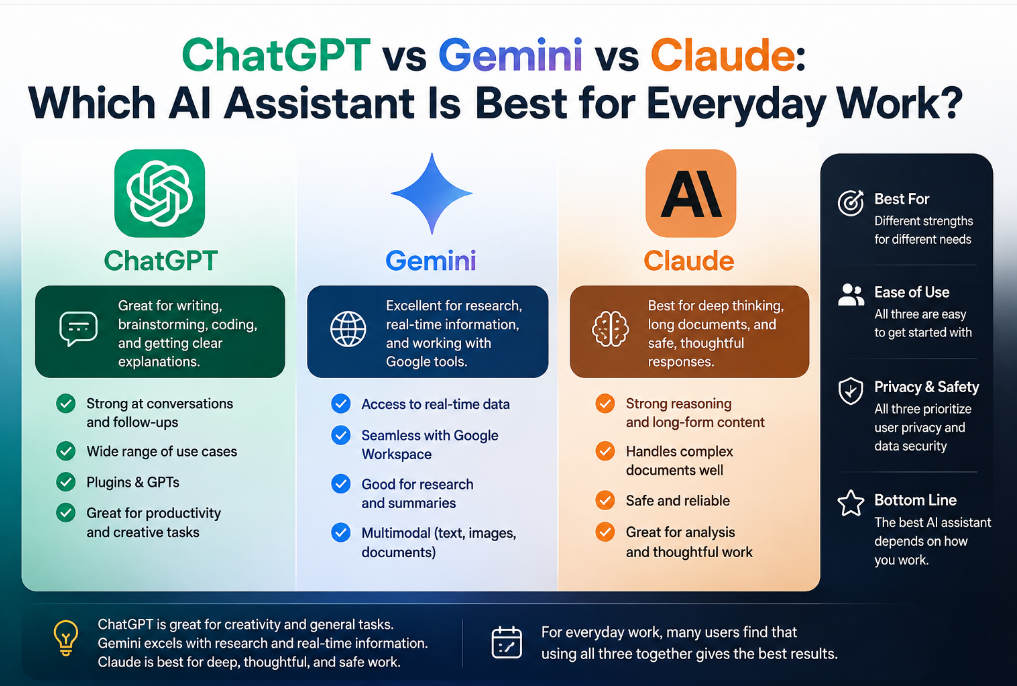
- ChatGPT (OpenAI) remains the pioneer and market leader in general-purpose conversational AI. Driven by advanced reasoning models and versatile plugins, ChatGPT is built to be an all-in-one digital Swiss Army knife. Whether you need to draft a legal contract, brainstorm viral marketing hooks, or write Python automation scripts, ChatGPT adapts dynamically to user instructions through custom GPTs and robust API integrations.
- Gemini (Google) is deeply rooted in Google’s massive data ecosystem and native real-time web connectivity. Designed from the ground up to be multi-modal—processing text, code, audio, image, and video simultaneously—Gemini excels at tasks requiring up-to-the-minute web retrieval, seamless integration with Google Workspace tools (Docs, Sheets, Gmail, Drive), and handling massive context windows with blinding speed.
- Claude (Anthropic) was built with a core focus on safety, constitutional AI alignment, nuanced human-like prose, and massive document analysis. Claude is widely celebrated by writers, software engineers, and researchers for its exceptional writing style, which largely avoids corporate buzzwords and robotic clichés, alongside its superior capability to ingest entire books, research papers, or software repositories in a single prompt.
2. Feature-by-Feature Comparison Matrix
To give you a clear structural overview of how these three platforms stack up against each other for professional deployment, consider the following comparison table:
| Feature / Capability | ChatGPT (OpenAI) | Gemini (Google) | Claude (Anthropic) |
| Primary Strength | General versatility, Custom GPTs, Task automation | Ecosystem integration, Real-time web data, Multi-modality | Nuanced writing, Long-form code analysis, Deep document reasoning |
| Context Window | Large (Up to 128k+ tokens in standard flagship models) | Massive (Up to 1M–2M+ tokens in Gemini 1.5 Pro) | Very Large (Up to 200k+ tokens with high precision retention) |
| Ecosystem Synergy | Microsoft Copilot integration, Zapier, Custom APIs | Native Google Workspace (Docs, Drive, Gmail, Sheets) | Standalone web app, API-first development tools |
| Writing Tone | Structured, polite, slightly formal or formulaic | Informative, concise, search-optimized | Deeply natural, literary, adaptable, highly articulate |
| Best Suited For | Everyday administrative tasks, multi-step agent workflows | Research requiring live web data and Google file synergy | Long-form editing, software architecture, academic critique |
3. Real-World Use Cases: Where Each AI Assistant Shines
Theoretical specifications matter little if an AI cannot solve practical problems on a Tuesday afternoon. Let us examine how each model performs in distinct professional scenarios.
Use Case A: Market Research and Real-Time Data Retrieval (Winner: Gemini)
Imagine you are preparing an urgent pitch deck and need to analyze the latest Q2 economic trends in global cloud computing, complete with recent acquisitions and statistics from the past 48 hours. When tasked with live web search integration, Gemini outperforms its peers due to its direct tether to Google Search. It crawls live web pages rapidly, synthesizes sources accurately, and cites URLs cleanly. While ChatGPT features web browsing capabilities via Bing, Gemini feels more native and comprehensive when pulling fresh data from diverse web domains.
Use Case B: Comprehensive Document Analysis and Codebase Refactoring (Winner: Claude)
Picture a software engineer or legal counsel who needs to upload a 300-page regulatory compliance document or a legacy software repository containing 50 individual script files. Claude excels exceptionally in this arena. Its Needle-in-a-Haystack retrieval accuracy across enormous context windows ensures that subtle clauses on page 184 or obscure variable dependencies in nested code folders are not hallucinated or overlooked. Furthermore, Claude’s prose in summarizing complex legal or technical jargon reads like it was written by a meticulous human expert.
Use Case C: General Productivity, Task Automation, and Custom Workflows (Winner: ChatGPT)
For everyday administrative operations—such as drafting client follow-up emails, creating social media content calendars, converting messy CSV data into structured markdown, or utilizing specialized Custom GPTs built for specific niche tasks—ChatGPT remains the most adaptable daily driver. Its extensive ecosystem of plugins, voice mode capabilities, and reliable prompt adherence make it an indispensable assistant for general office workers.
4. Pros and Cons of Each AI Assistant
To ensure a balanced evaluation, let’s look closely at the distinct advantages and limitations of each platform when integrated into professional routines.
- ChatGPT (OpenAI)
- Pros: Extremely versatile across varied tasks, Custom GPT marketplace for specialized workflows, robust mobile app with advanced voice features.
- Cons: Can sometimes sound formulaic or over-reliant on predictable transition words; context window size is smaller than Gemini’s flagship tiers.
- Google Gemini
- Pros: Unmatched real-time web retrieval via Google Search, massive context window capable of ingesting entire video files or books, direct integration with Google Docs, Gmail, and Drive.
- Cons: Occasionally prone to overly cautious or brief answers on complex topics; UI layout can sometimes feel cluttered with search fluff.
- Claude (Anthropic)
- Pros: Superior prose quality, highly analytical document comprehension, exceptional coding logic, and minimal robotic phrasing. Great for professional editing.
- Cons: Lacks native live web search capabilities comparable to Gemini, and its ecosystem integrations are narrower compared to OpenAI and Google.
5. Optimizing Your Workflow: Can You Use All Three?
Many modern professionals find that relying on a single AI assistant is unnecessarily restrictive. Just as a master craftsman does not use only a hammer for every woodworking task, savvy knowledge workers often adopt a multi-tool AI stack:
- Use Gemini for market research, scouring live news, and summarizing documents stored inside your Google Drive.
- Switch to Claude when you need to write long-form essays, review dense technical contracts, or debug intricate software architecture.
- Rely on ChatGPT for quick daily administrative templates, voice-dictated brainstorming sessions, and specialized Custom GPT utilities.
By understanding how these systems complement one another, you can drastically boost your daily output. To explore more about how automation tools integrate with enterprise software, check out our insights on Seamless Integration: The Power of CRM and ERP United or explore our guide on The Ultimate Guide to Finding the Best CRM SaaS for Your Business.
6. Conclusion
There is no single “winner” in the battle between ChatGPT, Gemini, and Claude; rather, the best AI assistant is entirely dependent on your professional DNA. If your workday revolves around rapid web research and Google Workspace files, Gemini is your ideal partner. If your career demands meticulous document review, long-form writing, and deep technical coding, Claude stands unmatched. If you require a flexible, all-purpose assistant with robust custom app builders, ChatGPT remains the gold standard.
Ultimately, the true competitive advantage in 2026 does not belong to the AI model itself, but to the professional who knows precisely when and how to deploy each tool.