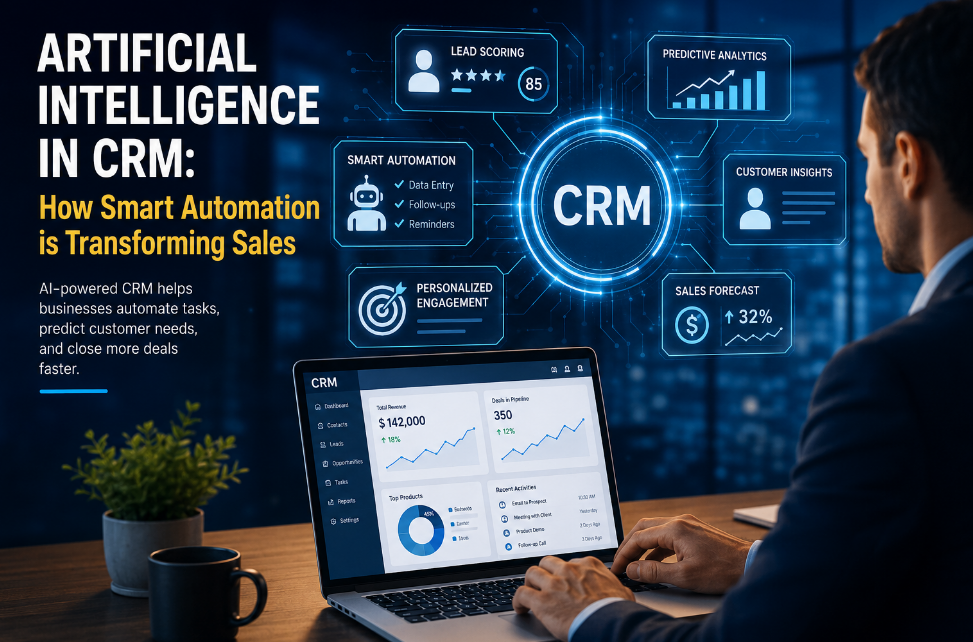
In today’s highly competitive business environment, companies are constantly looking for ways to understand customers better, improve sales performance, and reduce repetitive work. Customer Relationship Management (CRM) systems have long played an important role in helping businesses manage customer data, sales pipelines, communication, and relationships. However, the introduction of Artificial Intelligence (AI) is taking CRM technology to an entirely new level.
Artificial Intelligence in CRM is transforming traditional customer management systems into intelligent platforms that can analyze data, predict customer behavior, automate repetitive tasks, and provide valuable recommendations to sales teams. Instead of simply storing information, modern AI-powered CRM systems can actively help businesses decide what to do next.
Smart automation is becoming one of the most important developments in modern sales. Sales representatives no longer need to spend as much time manually entering data, sorting leads, sending follow-up emails, or searching for customer information. AI can automate many of these processes, allowing sales teams to focus on what matters most: building relationships and closing deals.
This article explores how Artificial Intelligence is transforming CRM systems and reshaping the future of sales.
Understanding Artificial Intelligence in CRM
Artificial Intelligence refers to computer systems designed to perform tasks that normally require human intelligence. These tasks can include recognizing patterns, understanding language, making predictions, learning from data, and generating recommendations.
When AI is integrated into a CRM platform, it can process large amounts of customer information much faster than a human employee. CRM systems typically contain valuable data such as customer contact details, purchase history, website activity, emails, support conversations, and previous interactions.
AI can analyze this information and identify patterns that might otherwise be difficult to detect.
For example, an AI-powered CRM system may recognize that customers who download a specific product guide and visit a pricing page multiple times are more likely to make a purchase. The system can then automatically alert a sales representative or assign the customer a higher lead score.
This changes CRM from a passive database into an active sales assistant.
Instead of asking, “What information do we have about this customer?” businesses can begin asking, “What is the best action to take next?”
AI-Powered Lead Scoring
One of the most significant applications of AI in CRM is intelligent lead scoring.
Traditional lead scoring often depends on simple rules created manually by sales and marketing teams. For example, a business might assign points when a potential customer fills out a form, opens an email, or visits a product page.
While this method can be useful, it has limitations. Human-created rules may not always reflect real customer behavior.
AI-powered lead scoring can analyze historical sales data and identify which behaviors are most strongly connected to successful conversions. The system can learn from previous customers and compare new leads with patterns found in successful sales.
As a result, sales teams can prioritize leads that are more likely to become customers.
Imagine a company receiving thousands of potential leads every month. Without AI, sales representatives may spend significant amounts of time contacting people who have little interest in buying.
With intelligent lead scoring, the CRM can automatically identify high-potential prospects.
Sales representatives can then focus their attention on opportunities with the highest probability of success.
This improves efficiency and can increase conversion rates.
Predictive Analytics and Sales Forecasting
AI is also changing the way companies forecast sales.
Traditional sales forecasting often depends on historical numbers, spreadsheets, and the opinions of sales managers. Although experience remains valuable, AI can provide additional insights by analyzing much larger datasets.
Predictive analytics uses historical information and machine learning models to estimate future outcomes.
An AI-powered CRM can analyze factors such as:
- Previous sales performance
- Customer purchasing patterns
- Seasonal trends
- Sales cycle length
- Marketing activity
- Deal progression
- Customer engagement
Based on these patterns, the system can estimate which deals are most likely to close and which opportunities may require additional attention.
For sales managers, this provides a clearer view of the pipeline.
Instead of relying entirely on subjective predictions from sales representatives, managers can use AI-generated insights to identify potential risks and opportunities.
For example, if a deal has remained in the same stage for an unusually long period, AI may identify it as being at risk. The system can alert the sales representative and recommend a follow-up action.
Better forecasting allows businesses to make smarter decisions about inventory, staffing, marketing budgets, and revenue planning.
Automating Repetitive Sales Tasks
Sales professionals often spend a surprising amount of time on administrative work.
Tasks such as entering customer information, updating CRM records, scheduling meetings, sending follow-up emails, and creating reports can consume hours every week.
AI-powered automation helps reduce this burden.
Modern CRM systems can automatically capture information from emails, calls, meetings, and customer interactions. AI can identify important details and add them to customer records.
For example, after a sales call, an AI system may generate a summary of the conversation and identify:
- Customer needs
- Important questions
- Potential objections
- Competitors mentioned
- Next steps
- Follow-up deadlines
This information can automatically be stored in the CRM.
Sales representatives no longer need to manually write detailed notes after every conversation.
AI can also automate routine communication. If a customer requests information but does not respond, the CRM can automatically send a personalized follow-up message after a specific period.
However, automation does not mean communication must become robotic.
AI can personalize messages based on customer behavior, interests, industry, and previous interactions. This makes automated communication more relevant and useful.
Personalized Customer Experiences
Modern customers expect businesses to understand their needs.
Generic sales messages are becoming less effective because customers receive enormous amounts of digital communication every day.
AI allows CRM systems to create more personalized experiences.
By analyzing customer data, AI can recommend products, services, content, and communication strategies that are relevant to each individual.
For example, an e-commerce company may use AI to recommend products based on previous purchases and browsing behavior.
A software company may identify which features a customer uses most frequently and recommend advanced tools that could provide additional value.
Personalization can also improve the timing of communication.
Instead of sending emails at the same time to every customer, AI can analyze engagement patterns and determine when a particular customer is most likely to respond.
This creates a more targeted sales approach.
The result is not simply more communication. It is better communication.
AI Chatbots and Virtual Sales Assistants
AI-powered chatbots have become another important component of modern CRM strategies.
Traditional chatbots often followed simple scripts. They could answer basic questions but struggled when conversations became more complex.
Modern AI systems can understand natural language and respond more intelligently.
AI chatbots can assist customers at any time of day, answering common questions and collecting important information.
For example, a chatbot on a company website can ask visitors about their needs, recommend relevant products, and collect contact information.
The CRM can then automatically create a new lead and assign it to the appropriate sales representative.
Virtual sales assistants can also support internal teams.
They may help sales representatives find customer information, summarize recent interactions, prepare meeting notes, or suggest the next best action.
Imagine asking a CRM assistant:
“What are the biggest risks in my sales pipeline this month?”
The AI could analyze the available data and provide a summary within seconds.
This reduces the time required to search through dashboards and reports.
Improving Customer Retention
AI in CRM is not only useful for acquiring new customers. It can also help businesses retain existing customers.
Customer retention is extremely important because losing customers can significantly affect long-term revenue.
AI can analyze customer behavior and identify warning signs that a customer may be losing interest.
For example, the system may detect that a customer has:
- Reduced product usage
- Stopped opening emails
- Submitted multiple support complaints
- Reduced purchase frequency
- Avoided communication
These signals may indicate a higher risk of customer churn.
The CRM can automatically alert the customer success or sales team.
The company can then take action before the customer decides to leave.
AI may also recommend specific retention strategies based on similar customers from the past.
This allows businesses to become proactive rather than reactive.
Instead of waiting for customers to complain or cancel, companies can identify problems earlier.
Smarter Sales Recommendations
One of the most powerful concepts in AI-powered CRM is the “next best action.”
Sales representatives often need to decide what to do next for dozens or even hundreds of prospects.
Should they send an email?
Schedule a meeting?
Offer a discount?
Share a product demonstration?
Wait for the customer?
AI can analyze available data and recommend the action most likely to move the relationship forward.
For example, the CRM might suggest:
“Schedule a follow-up call within the next 48 hours.”
Or:
“This customer has viewed the enterprise pricing page three times. Consider sending a customized proposal.”
These recommendations can help inexperienced sales representatives make better decisions while also improving consistency across the sales team.
Experienced sales professionals still provide judgment, empathy, and relationship-building skills. AI simply gives them additional information and support.
The best results often come from combining human intelligence with artificial intelligence.
Improving Sales Productivity
The main benefit of AI automation is productivity.
When sales teams spend less time performing repetitive administrative tasks, they have more time to focus on high-value activities.
These activities include:
- Building customer relationships
- Understanding customer problems
- Preparing proposals
- Negotiating deals
- Conducting product demonstrations
- Developing sales strategies
AI does not necessarily replace sales professionals.
Instead, it can act as a productivity multiplier.
A sales representative supported by AI may be able to manage more leads, respond faster, and make better decisions.
This is especially valuable for small businesses with limited sales teams.
A small company may not have enough employees to manually analyze thousands of customer interactions.
AI-powered CRM automation can help smaller organizations operate with greater efficiency.
Challenges and Risks of AI in CRM
Despite its advantages, AI in CRM also presents several challenges.
The first challenge is data quality.
AI systems depend on data. If CRM records are incomplete, outdated, or inaccurate, the recommendations generated by AI may also be unreliable.
Businesses must maintain clean and organized customer data.
Privacy is another important concern.
CRM systems often contain sensitive customer information. Companies must handle this data responsibly and follow relevant privacy regulations.
Businesses should also be transparent about how customer information is collected and used.
Another challenge is over-automation.
Customers do not want every interaction to feel like it is generated by a machine.
Automation should improve the customer experience, not remove the human element.
For important conversations, negotiations, complaints, or complex problems, human communication remains essential.
Companies should use AI to support employees rather than blindly automate every decision.
Training is also important.
Sales teams need to understand how AI recommendations are generated and how they should be used.
AI should be viewed as a decision-support tool, not an unquestionable authority.
The Future of AI-Powered CRM
The future of CRM will likely become even more intelligent and automated.
AI systems are expected to improve their ability to understand conversations, predict customer needs, and generate personalized recommendations.
Future CRM platforms may automatically prepare sales strategies for individual customers.
They could analyze previous interactions, market conditions, competitor activity, and customer behavior to recommend the best approach.
Voice-based CRM assistants may also become more common.
Sales representatives could update records and retrieve information simply by speaking.
Generative AI may help create personalized emails, sales proposals, meeting summaries, and marketing content.
However, the future of sales will not be completely automated.
Trust, empathy, creativity, and human relationships remain critical.
The most successful companies will likely be those that use AI to handle data-heavy and repetitive tasks while allowing employees to focus on meaningful human interaction.
Conclusion
Artificial Intelligence is transforming CRM from a simple customer database into an intelligent business platform.
AI-powered automation can score leads, predict sales outcomes, personalize customer experiences, automate repetitive tasks, identify churn risks, and recommend the next best action.
For sales teams, this means spending less time on administrative work and more time building valuable relationships.
For businesses, it means better efficiency, improved forecasting, stronger customer retention, and greater opportunities for revenue growth.
However, AI is not a replacement for human sales professionals. Technology is most effective when combined with human judgment, communication, and empathy.
The future of sales will belong to organizations that successfully combine smart automation with strong human relationships.
As AI technology continues to evolve, CRM systems will become increasingly capable of understanding customers and supporting better business decisions. Companies that adopt these technologies strategically will be better positioned to compete in an increasingly data-driven marketplace.
Artificial Intelligence is no longer just a futuristic concept in customer relationship management. It is already changing how businesses find prospects, communicate with customers, manage sales pipelines, and close deals.
The question is no longer whether AI will transform CRM.
The transformation has already begun.