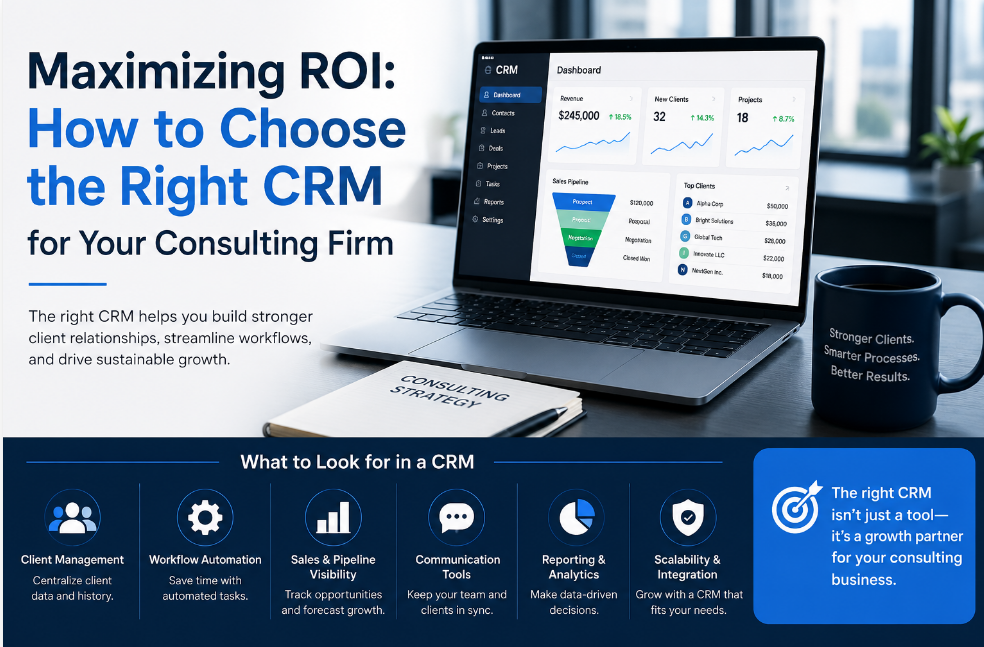
For consulting firms, relationships are the foundation of business. Winning a new client often requires weeks or months of communication, proposals, meetings, negotiations, and follow-ups. At the same time, consultants must maintain strong relationships with existing clients while identifying new opportunities.
As a consulting firm grows, managing all of these relationships manually becomes increasingly difficult. Customer information may be scattered across spreadsheets, emails, calendars, messaging applications, and individual employee notes. This can lead to missed follow-ups, inconsistent communication, and lost sales opportunities.
A Customer Relationship Management (CRM) system can solve many of these challenges. However, choosing the right CRM is not simply about selecting the platform with the most features. The real objective is to choose a system that produces measurable business value.
For consulting firms, this means considering how effectively a CRM can improve productivity, increase client retention, accelerate sales cycles, and generate additional revenue.
In this article, we explore how consulting firms can choose the right CRM while maximizing their return on investment (ROI).
What Does CRM ROI Mean for a Consulting Firm?
CRM ROI refers to the financial value a business receives compared with the cost of implementing and operating its CRM system.
A simple way to think about CRM ROI is:
CRM ROI = Financial Gains from CRM − Total CRM Costs
The gains may come from several sources, including increased sales, improved client retention, reduced administrative work, and better employee productivity.
For a consulting firm, CRM ROI might result from:
- More qualified leads
- Higher proposal conversion rates
- Faster follow-ups
- Increased client retention
- More repeat business
- Better account management
- Reduced administrative work
- Improved sales forecasting
The important point is that CRM value is not always immediately visible as direct revenue.
Saving consultants several hours of administrative work each week can also create significant financial value because those hours can be redirected toward billable client work or business development.
1. Understand Your Firm’s Specific Needs
Before comparing CRM platforms, identify the problems you want the CRM to solve.
Different consulting firms have different workflows.
A small management consulting company may primarily need lead management and proposal tracking. An IT consulting firm may require project integrations and technical support workflows. A large strategy consultancy may need advanced account management, forecasting, and reporting.
Start by documenting your current sales and client-management process.
Ask questions such as:
- How do we currently store client information?
- Where are leads coming from?
- How are sales opportunities tracked?
- How do consultants manage follow-ups?
- How are proposals created and monitored?
- How do we track existing client relationships?
- Where are important communication records stored?
- Which administrative tasks consume the most time?
The answers will help identify the CRM capabilities that matter most.
Avoid purchasing a platform simply because it has a long list of features. A CRM should solve real business problems rather than create additional complexity.
2. Prioritize Contact and Account Management
Consulting firms often have complex client relationships.
One company may have multiple decision-makers, departments, projects, and stakeholders. A CRM should allow consultants to organize these relationships clearly.
A strong contact management system should make it easy to view:
- Contact information
- Company details
- Previous interactions
- Meetings
- Emails
- Proposals
- Opportunities
- Previous projects
- Notes
- Follow-up activities
This creates a complete picture of the client relationship.
Instead of asking another consultant, “What happened with this client?”, employees can check the CRM and immediately understand the account history.
This becomes especially valuable when employees change roles or when multiple consultants work with the same organization.
3. Evaluate Lead and Opportunity Management
Generating leads is only the beginning of the consulting sales process.
The CRM should help consultants move prospects through each stage of the sales funnel.
A typical consulting sales pipeline might look like:
New Lead → Initial Contact → Discovery Meeting → Qualified Opportunity → Proposal → Negotiation → Won/Lost
The CRM should allow managers to see exactly where every opportunity stands.
This makes it easier to identify deals that require attention.
For example, if a high-value proposal has remained inactive for two weeks, the CRM can trigger a reminder.
Without a structured pipeline, opportunities can easily disappear inside email inboxes or spreadsheets.
A CRM that improves opportunity management can therefore have a direct impact on revenue.
4. Look for Automation Capabilities
Consultants should spend their time solving client problems, not performing repetitive administrative tasks.
CRM automation can significantly reduce manual work.
Useful automation features may include:
- Automatic follow-up reminders
- Lead assignment
- Email notifications
- Appointment scheduling
- Proposal reminders
- Task creation
- Customer segmentation
- Sales pipeline updates
- Automated reporting
For example, when a new consulting lead submits an inquiry form, the CRM could automatically create a contact record, assign the lead to the appropriate consultant, and schedule a follow-up task.
This reduces the possibility of leads being forgotten.
Automation becomes particularly valuable as the firm grows because the volume of customer interactions increases.
5. Consider Integration With Existing Tools
A CRM should not become another isolated application.
Consulting firms often rely on email, calendars, accounting systems, communication platforms, project-management tools, and document-storage services.
Before choosing a CRM, determine whether it integrates with the software your firm already uses.
Useful integrations may include:
- Email platforms
- Calendars
- Accounting software
- Marketing platforms
- Project-management systems
- Video conferencing
- Document storage
- Business intelligence tools
Integration reduces duplicate data entry and allows information to move between systems.
For example, connecting the CRM to a calendar can automatically associate meetings with client records.
This creates a smoother workflow and improves productivity.
6. Measure Ease of Use
One of the most overlooked factors when selecting CRM software is usability.
A CRM may have hundreds of advanced features, but if consultants find the system complicated, they may avoid using it.
Low adoption can destroy potential ROI.
Choose a platform with an intuitive interface and workflows that match how your team already works.
Before purchasing, allow several employees to test the platform.
Ask them:
- Is it easy to create a contact?
- Can you quickly find client information?
- Is updating an opportunity straightforward?
- Can you understand the dashboard?
- Does the system reduce or increase administrative work?
The people who will use the CRM every day should have a voice in the purchasing decision.
7. Calculate the Total Cost of Ownership
The subscription price is only one component of CRM costs.
A realistic ROI calculation should consider the entire cost of ownership.
Potential costs include:
- Monthly or annual subscriptions
- Implementation
- Data migration
- Customization
- Training
- Integration
- Technical support
- Additional users
- Premium features
A CRM with a low monthly price may become expensive if it requires extensive customization.
Conversely, a more expensive platform may generate greater ROI if it significantly improves productivity and revenue.
Always compare total costs against expected business benefits.
8. Choose a CRM That Can Scale
Consulting firms rarely remain the same size forever.
A company may start with five consultants and eventually grow to dozens or hundreds.
The CRM should be able to support that growth.
Look at:
- User limits
- Storage capacity
- Automation limits
- Reporting capabilities
- Integration options
- Custom fields
- Permission controls
- Advanced analytics
The goal is to avoid replacing the CRM every time the business reaches a new growth stage.
A scalable system allows the company to increase its CRM capabilities as its needs evolve.
9. Focus on Reporting and Analytics
A good CRM should not simply store information. It should help management understand what the data means.
Consulting firms can use CRM analytics to monitor:
- Lead conversion rates
- Proposal win rates
- Average sales cycle
- Revenue by consultant
- Revenue by service
- Client acquisition costs
- Client retention
- Pipeline value
- Forecasted revenue
These metrics provide insight into business performance.
For example, if a firm discovers that its proposal win rate is significantly higher for referrals than cold leads, management can invest more resources into referral strategies.
Data-driven decision-making can significantly improve marketing and sales efficiency.
10. Evaluate Client Retention Features
Winning new clients is important, but maintaining existing relationships can be even more valuable.
Consulting firms frequently generate additional revenue through repeat projects, expanded engagements, and referrals.
A CRM can help identify opportunities for account expansion.
For example, if a client previously purchased one consulting service, the CRM can remind the account manager to discuss another service that may be relevant.
The CRM can also track important relationship milestones and follow-up activities.
Consistent engagement helps prevent valuable client relationships from becoming inactive.
11. Consider AI-Powered CRM Features
Artificial Intelligence is increasingly becoming part of modern CRM platforms.
AI can help consulting firms analyze customer behavior, prioritize leads, summarize meetings, automate data entry, and predict sales opportunities.
Some systems can recommend the next best action for a particular prospect or identify accounts that may be at risk of leaving.
AI can also summarize client conversations so consultants do not need to review long email threads or meeting transcripts.
However, AI should be considered a productivity tool rather than the primary reason to purchase a CRM.
A reliable CRM foundation, accurate data, and strong adoption should come first.
12. Protect Client Data
Consulting firms often handle sensitive business information.
Therefore, security should be a major factor when selecting CRM software.
Evaluate features such as:
- User permissions
- Multi-factor authentication
- Encryption
- Audit logs
- Backup procedures
- Data access controls
- Security certifications
- Data privacy policies
Not every employee needs access to every client record.
A good CRM should allow administrators to control what different users can view and modify.
Data protection is not only an IT concern. It is also part of maintaining client trust.
13. Create a CRM Implementation Strategy
Choosing the CRM is only the first step.
Implementation can determine whether the investment succeeds.
Start by cleaning existing customer data before importing it into the new platform.
Remove duplicate contacts, correct outdated information, and establish consistent naming conventions.
Then define clear CRM procedures.
For example:
Every new lead must be entered into the CRM within 24 hours.
Every sales opportunity must have a defined next action.
Client communication should be recorded consistently.
Clear rules improve data quality and make reporting more reliable.
14. Train Employees Properly
Even the best CRM cannot produce ROI if employees do not know how to use it.
Training should focus on practical workflows rather than simply explaining every available feature.
Employees should understand how the CRM helps them.
Show consultants how automation can save time, how customer information can be accessed quickly, and how the CRM can reduce repetitive tasks.
When employees see the personal benefits, adoption tends to improve.
Ongoing training may also be necessary when new features are introduced or workflows change.
15. Measure CRM Performance After Implementation
CRM ROI should be measured continuously.
Before implementation, establish several baseline metrics.
These might include:
- Average sales cycle
- Number of qualified leads
- Proposal conversion rate
- Revenue per consultant
- Customer retention rate
- Administrative hours
- Follow-up completion rate
After implementing the CRM, compare these metrics over time.
If the sales cycle decreases while proposal conversion increases, the CRM may be producing measurable business value.
Regular measurement also helps identify areas that require improvement.
Common Mistakes to Avoid
Consulting firms should avoid several common CRM mistakes.
Choosing Too Many Features
More features do not automatically mean greater value.
Choose functionality that directly supports business objectives.
Ignoring Employee Feedback
A CRM selected entirely by management may fail if consultants dislike using it.
Include actual users in the evaluation process.
Poor Data Quality
Incorrect or incomplete data reduces the usefulness of CRM analytics.
Clean data should be treated as a priority.
Failing to Define Processes
Technology cannot fix an unclear sales process.
Establish clear procedures before implementing automation.
Measuring Only Software Costs
ROI should include productivity gains, increased revenue, improved retention, and reduced administrative work—not just subscription fees.
Conclusion
Choosing the right CRM for a consulting firm is ultimately a business decision, not simply a technology purchase.
The ideal platform should help consultants manage relationships, organize sales opportunities, automate repetitive tasks, improve collaboration, protect client information, and generate actionable insights.
Most importantly, the CRM should produce measurable value.
A consulting firm can maximize CRM ROI by first identifying its specific challenges, choosing features that address those challenges, evaluating total ownership costs, ensuring employee adoption, and continuously measuring business results.
The best CRM is not necessarily the most expensive or feature-rich platform. It is the one that fits the firm’s workflow, is easy for employees to use, scales with growth, and contributes directly to better client relationships and stronger financial performance.
When implemented strategically, a CRM can become much more than a database. It can become the central platform that connects sales, consultants, management, and clients—helping a consulting firm build stronger relationships, win more business, and maximize long-term growth.