Running a small business requires more than offering a great product or service. Business owners need to manage customers, track leads, monitor sales, organize communication, and build long-term relationships with clients. As a company grows, managing all of this information using spreadsheets, emails, and handwritten notes can quickly become difficult.
This is where a cloud-based Customer Relationship Management (CRM) system can make a significant difference.
A cloud-based CRM allows businesses to store and manage customer information through an online platform instead of relying on software installed on a single computer or a local server. Sales teams can access customer records, update information, monitor leads, and collaborate with colleagues from almost anywhere with an internet connection.
For small businesses, this technology can provide many of the capabilities traditionally associated with large enterprises without requiring a large IT department or expensive infrastructure.
From improving organization and productivity to strengthening customer relationships and supporting business growth, cloud-based CRM solutions can become an important part of a modern small-business strategy.
What Is a Cloud-Based CRM?
A cloud-based CRM is customer relationship management software that operates through cloud infrastructure. Instead of storing CRM data exclusively on a company’s local computers, information is hosted on remote servers and accessed through the internet.
Users typically log in through a web browser or mobile application.
A cloud CRM can store information such as:
- Customer contact details
- Sales opportunities
- Lead information
- Communication history
- Purchase records
- Follow-up schedules
- Sales activities
- Customer service interactions
- Marketing information
Because the information is centralized, authorized employees can access the same customer data without maintaining multiple spreadsheets or databases.
This creates a single source of information for sales, marketing, and customer service teams.
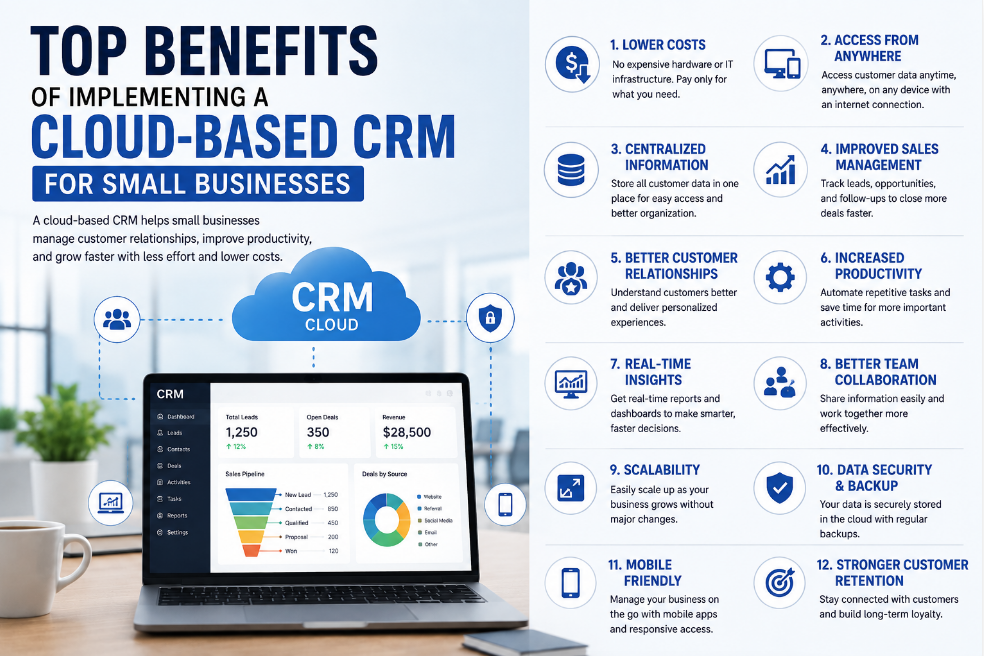
1. Lower Upfront Costs
One of the biggest advantages of cloud-based CRM software for small businesses is reduced infrastructure costs.
Traditional CRM systems may require companies to purchase servers, install software, maintain hardware, and employ technical personnel to manage the infrastructure.
These expenses can be difficult for small businesses to justify.
Cloud-based CRM solutions typically operate through subscription-based pricing. Businesses can choose a plan according to their needs and number of users rather than investing heavily in hardware.
This makes CRM technology more accessible to startups and growing companies.
Instead of spending a large amount of money before seeing results, a small business can begin with a basic plan and expand its subscription as the company grows.
2. Easy Access From Anywhere
Modern businesses are not always tied to a traditional office.
Employees may work remotely, travel to meet customers, or operate from different locations.
A cloud-based CRM makes customer information accessible from almost anywhere with a reliable internet connection.
For example, a salesperson visiting a potential customer can quickly check the client’s previous interactions, purchase history, open opportunities, and notes before starting a meeting.
Similarly, a business owner traveling outside the office can review sales activity using a laptop or smartphone.
This flexibility is especially valuable for small businesses where employees often perform multiple roles.
3. Centralized Customer Information
Without a CRM, customer information can become scattered across different systems.
One employee might store contacts in a spreadsheet, another may use email folders, and another may keep information in personal notes.
This creates confusion and increases the possibility of losing important information.
A cloud-based CRM centralizes customer data in one location.
Sales representatives can see previous conversations, customer preferences, sales opportunities, and follow-up activities without searching through multiple applications.
Having centralized information also improves continuity.
If one employee leaves the company, other team members can continue serving customers because important information remains inside the CRM.
4. Improved Sales Organization
Small businesses often struggle with managing multiple leads simultaneously.
Some prospects may require a follow-up next week, while others may be ready to purchase immediately.
Without a structured system, sales opportunities can easily be forgotten.
A cloud-based CRM helps organize leads through different stages of the sales funnel.
For example, a business might categorize prospects as:
New Lead → Contacted → Qualified → Proposal → Negotiation → Closed
Sales representatives can quickly see where each opportunity stands.
CRM reminders can also notify employees when a follow-up is due.
This reduces the risk of missed opportunities and helps create a more consistent sales process.
5. Better Customer Relationships
Customer relationships are particularly important for small businesses.
Large companies may have extensive marketing budgets, but small businesses can often compete through personalized service and strong customer relationships.
A CRM provides employees with information that helps them understand individual customers.
For example, before contacting a returning customer, an employee can review previous purchases and conversations.
Instead of asking the customer to explain their history again, the employee can immediately continue the conversation.
This creates a smoother and more personalized experience.
Customers are more likely to appreciate businesses that remember their preferences and understand their needs.
6. Increased Employee Productivity
Administrative tasks can consume a significant amount of time.
Sales employees may spend hours updating spreadsheets, searching for customer information, writing reports, and creating reminders.
Cloud-based CRM systems can automate many of these repetitive activities.
Depending on the platform, CRM automation can help with:
- Follow-up reminders
- Email notifications
- Lead assignment
- Customer segmentation
- Data organization
- Sales reports
- Appointment scheduling
- Marketing campaigns
By reducing repetitive administrative work, employees can spend more time on activities that directly contribute to business growth.
For sales teams, this means more time talking to prospects and customers.
7. Real-Time Sales Visibility
Business owners need to know how their company is performing.
Traditional spreadsheets can provide useful information, but they may become outdated quickly.
Cloud CRM dashboards can provide real-time visibility into important sales metrics.
Business owners and managers can monitor information such as:
- Number of active leads
- Open sales opportunities
- Revenue generated
- Sales conversion rates
- Individual sales performance
- Upcoming follow-ups
- Customer acquisition trends
This makes it easier to identify problems before they become serious.
For example, if the number of new leads suddenly decreases, management can investigate the issue and adjust its marketing strategy.
8. Better Collaboration
Small businesses often have employees performing different responsibilities.
Sales, marketing, customer service, and management may need access to the same customer information.
A cloud-based CRM creates a shared environment where authorized employees can collaborate.
A salesperson can update a customer’s status, and the customer service team can immediately see the latest information.
Marketing employees can also use CRM data to understand customer segments and create more relevant campaigns.
This reduces communication gaps between departments.
Instead of operating as separate teams, employees can work from the same information.
9. Scalable as the Business Grows
Small businesses need technology that can grow with them.
A CRM that works for five employees may eventually need to support 20, 50, or more users.
Cloud-based platforms are generally designed to scale.
As the company gains more customers and employees, businesses can often upgrade their plans and add additional features.
This is more flexible than purchasing new servers or completely replacing an existing system.
Scalability is especially important for startups because their future needs may be difficult to predict.
A cloud CRM allows businesses to start small and expand gradually.
10. Improved Data Security and Backup
Losing customer data can be devastating for a small business.
Local computers can experience hardware failures, accidental deletion, or other technical problems.
Cloud-based CRM providers typically maintain infrastructure designed to protect and back up customer information.
Security features may include:
- User authentication
- Access controls
- Data encryption
- Automatic backups
- Activity monitoring
- Permission management
However, businesses should still evaluate the security policies of a CRM provider before choosing a platform.
Employees should also use strong passwords and appropriate access permissions.
Cloud technology does not eliminate security risks, but it can provide a more structured approach to data protection than relying entirely on individual computers.
11. Mobile-Friendly Business Operations
Many cloud CRM platforms provide mobile applications.
This allows employees to manage customer information while working outside the office.
A salesperson can update a lead immediately after a meeting instead of waiting until returning to the office.
A business owner can review sales performance from a smartphone.
Customer service employees can access relevant information while assisting customers remotely.
Mobile access creates greater flexibility and reduces delays in updating important information.
12. Powerful Reporting and Analytics
Data is one of the most valuable resources available to a business.
However, raw data is not useful unless it can be transformed into meaningful insights.
Cloud-based CRM platforms often include reporting and analytics tools that help businesses understand their customers and sales performance.
Reports can reveal:
- Which products generate the most revenue
- Which marketing channels produce the best leads
- Which sales representatives perform best
- How long customers typically take to make a purchase
- Which customer segments are most valuable
These insights help business owners make decisions based on actual information rather than assumptions.
Over time, better data-driven decisions can improve marketing, sales, and customer retention strategies.
13. Stronger Customer Retention
Acquiring new customers can be expensive.
For many small businesses, retaining existing customers is therefore extremely important.
A CRM helps businesses maintain consistent communication with existing customers.
Automated reminders can notify employees when it is time to contact a customer.
Businesses can also use customer data to identify purchasing patterns and create personalized offers.
For example, if a customer regularly purchases a particular product, the business can send a reminder or recommendation when a related product becomes available.
This type of proactive communication can strengthen customer loyalty.
14. Faster Implementation
Traditional business software can require significant installation and technical configuration.
Cloud-based CRM platforms are generally easier to deploy because the core infrastructure is managed by the provider.
Employees can often access the system through a browser or mobile application after their accounts are created.
This allows small businesses to begin organizing customer information without waiting for a lengthy hardware installation process.
However, successful implementation still requires proper planning.
Businesses should establish clear processes for data entry, user permissions, customer categories, and sales stages.
15. Supports Long-Term Business Growth
Ultimately, the biggest benefit of a cloud-based CRM is that it creates a foundation for sustainable growth.
As a business gains more customers, the amount of information it needs to manage increases.
Without a structured CRM system, complexity can quickly become overwhelming.
A cloud CRM provides a centralized platform that can support sales, marketing, customer service, reporting, and collaboration.
It helps businesses move from informal customer management toward a more organized and scalable operation.
What Should Small Businesses Consider Before Choosing a CRM?
Although cloud-based CRM systems offer many advantages, businesses should choose carefully.
Before purchasing a CRM, consider factors such as:
Ease of Use
A powerful system is not useful if employees find it too complicated.
Choose a platform with an intuitive interface and straightforward workflows.
Pricing
Compare subscription costs carefully.
Consider the number of users, available features, storage limits, and potential additional charges.
Integration
Check whether the CRM integrates with tools the business already uses, such as email platforms, accounting software, calendars, marketing tools, and communication applications.
Security
Review the provider’s security practices, authentication options, access controls, backup procedures, and data protection policies.
Scalability
Choose a CRM that can accommodate future growth without requiring a complete system replacement.
Conclusion
A cloud-based CRM can provide significant advantages for small businesses looking to improve customer management, sales productivity, and operational efficiency.
From lower infrastructure costs and remote accessibility to centralized customer information, automation, analytics, and improved collaboration, cloud CRM technology gives smaller organizations access to tools that can help them compete more effectively.
The most important benefit, however, is not the technology itself. It is the ability to use customer information more effectively.
When employees have access to accurate and organized data, they can respond faster, personalize interactions, identify opportunities, and build stronger relationships.
For small businesses planning to grow, investing in a cloud-based CRM can therefore be more than a software decision. It can become a strategic step toward creating a more organized, efficient, and customer-focused business.
As digital competition continues to increase, businesses that understand their customers and respond quickly to their needs will have a significant advantage. A well-implemented cloud-based CRM provides the infrastructure needed to make that possible.